Sourdough Bread: How to achieve a true open crumb in 5 steps
What Makes a True Open Crumb Sourdough?
The Complete Guide for Sourdough Enthusiasts: from bulk fermentation to scoring technique
If you’ve spent any time in the sourdough community (scrolling crumb shots, debating hydration ratios, obsessing over ear development) you already know that an open crumb is the holy grail. But what actually creates that airy, irregular, Instagram-worthy interior? The answer isn’t one thing. It’s a sequence.
1. It starts with your wild yeast starter
A healthy, active starter culture is non-negotiable. Your wild yeast needs to be at peak activity (risen, bubbly, and passing the float test) before it touches your dough. A sluggish levain produces a tight, dense crumb no matter how perfect your technique is. At Goodie Corner, our Country Miche is built on a 50-year-old starter that’s been fed and maintained daily. That age and consistency translates directly into flavour complexity and reliable fermentation behaviour.
2. Hydration is your biggest lever
High-hydration sourdough (75% and above) is the most reliable path to an open crumb. More water means more extensible gluten strands, which stretch rather than tear as gas bubbles expand during fermentation and baking. Our Golden Turmeric & Sesame batard sits at 82% hydration. It’s a slack, sticky dough that demands confidence, but the crumb structure it produces is unlike anything a lower-hydration loaf can achieve.
Goodie Corner tip: If you’re new to high-hydration doughs, add water gradually over multiple bakes rather than jumping straight to 80%+. Each 5% increase in hydration changes how the dough handles extensibility, stickiness, shaping tension so give yourself room to learn.
3. Bulk fermentation: the most critical variable
Bulk fermentation is where most home bakers go wrong : either cutting it short (dense crumb) or letting it overproof (collapsed structure). The right endpoint varies with ambient temperature, starter strength, and flour protein content. Look for 50–75% volume increase and a dough that jiggles, feels airy, and has visible bubbles on the surface and sides.
4. Cold retard: the flavour multiplier
Once shaped, most of our loaves at Goodie Corner go into a cold retard (anywhere from 16 to 72 hours in a 4°C fridge). This slow, cold long fermentation does two things: it deepens flavour through extended organic acid development, and it firms the dough, making it dramatically easier to score cleanly. The Midnight Loaf, our 72-hour cold-fermented sourdough, spends three full days developing flavour before it ever sees the oven.
5. Scoring: the final act
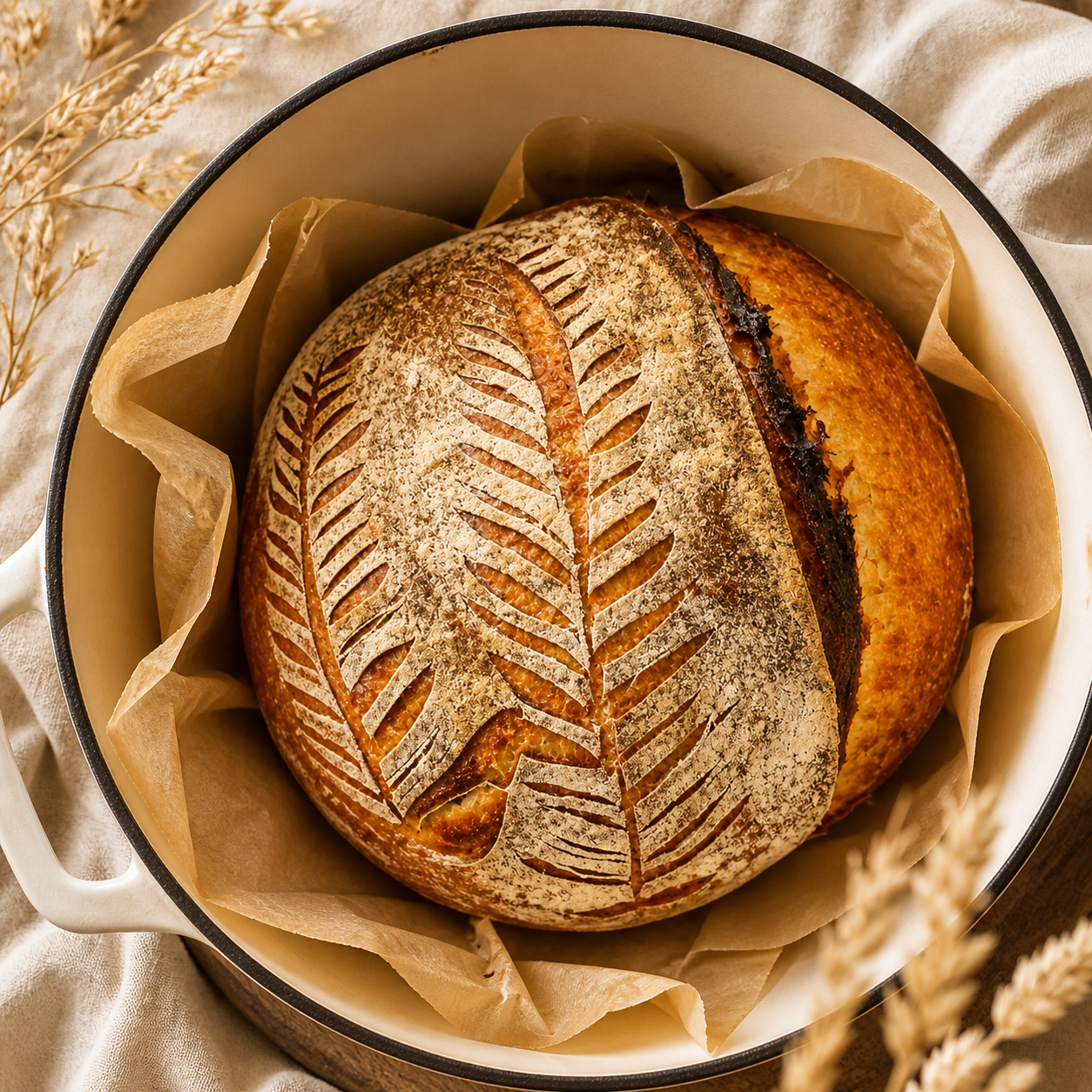
Sourdough scoring technique controls where the loaf opens. A single bold slash at 30–45° with a sharp lame allows maximum oven spring and creates the signature ear that experienced bakers recognise instantly. A cold dough scores cleaner : another reason the cold retard step isn’t optional for serious results.
The Goodie Corner difference: Every loaf we bake is scored by hand on a stone deck oven preheated to 250°C. The immediate blast of retained heat is what drives oven spring. A domestic oven with a preheated Dutch oven comes closest to replicating this at home.
Open crumb sourdough isn’t luck. It’s the accumulated result of good starter health, appropriate hydration, patient fermentation, and confident technique. Whether you bake your own or order from us : understanding what goes into the loaf makes every bite more meaningful.
Share your crumb shots : we want to see your bakes.
Every sourdough journey is different : your starter, your kitchen temperature, your flour. We’d love to hear about yours. Did you nail that open crumb on the first try? Still chasing it? Don’t hesitate to reach out directly to our team of passionate bakers. We read every message, and there’s no question too basic or too nerdy. Whether it’s troubleshooting a tight crumb, dialling in your bulk fermentation timing, or just wanting to geek out over hydration ratios. We’re here for all of it !